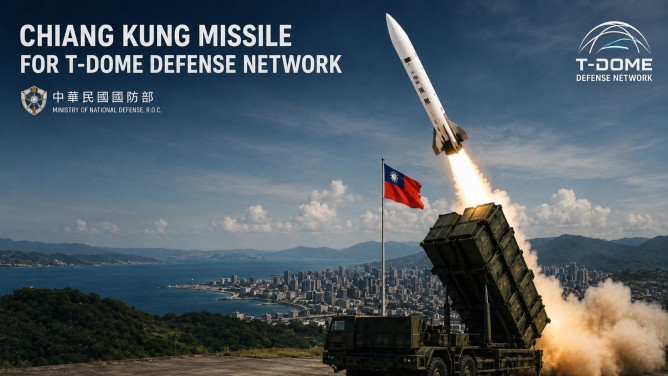
In a significant development for Taiwan’s defense capabilities, the National Chungshan Institute of Science and Technology (NCSIST) has unveiled the technical details of the Chiang Kung missile. This high-altitude interceptor, also referred to as Tien Chien IV, is poised to play an integral role in Taiwan’s envisioned “T-Dome” integrated air defense system. The missile is engineered to counter ballistic missiles at altitudes reaching up to 70 kilometers, addressing a crucial gap in Taiwan’s current defensive measures.
The Chiang Kung missile employs a land-based vertical launch system alongside a two-stage solid-propellant rocket, featuring vectored thrust to enhance high-altitude maneuverability. This advanced system is equipped with radar capable of detecting various targets and engaging multiple tactical ballistic missiles simultaneously, even under electronic warfare conditions. Furthermore, the missile includes a mobile active electronically scanned array radar, designed to operate effectively in environments compromised by electromagnetic interference and GPS jamming.
This high-altitude interception capability is deemed essential for strengthening Taiwan’s air defense, complementing existing systems within the proposed T-Dome network. However, the project faces financial hurdles, as the missile was omitted from Taiwan’s special defense budget. To address this, the Ministry of National Defense is pursuing additional funding through a supplementary budget. The acquisition schedule and broader development of the T-Dome network are at risk if there are delays in securing these funds.
With Taiwan seeking to bolster its defense infrastructure amid regional tensions, the introduction of the Chiang Kung missile represents a strategic enhancement to its military arsenal. Nonetheless, the success of this initiative hinges on navigating the financial uncertainties that currently cloud its progress. As Taiwan continues to prioritize its defense capabilities, securing the necessary resources for the Chiang Kung missile will be crucial in ensuring the timely advancement of the T-Dome air defense network.