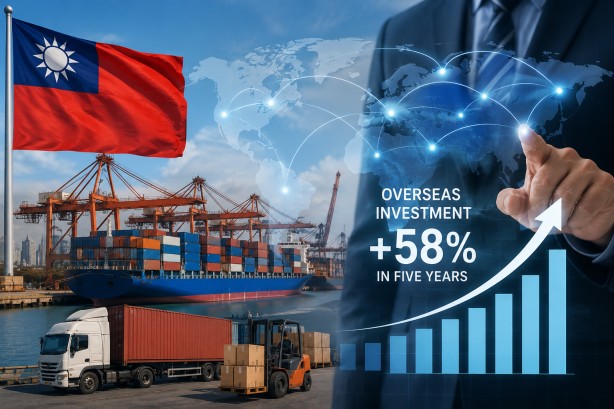
Taiwan has seen a significant increase in its approved overseas investments, surging by nearly 58% over the last five years as businesses seek to diversify their production bases and lessen their dependency on China. This trend was highlighted by the Ministry of Economic Affairs, which reported that approved outbound investments amounted to $148.6 billion from 2021 to 2025, a substantial rise from the $94.1 billion recorded between 2016 and 2020.
The ministry attributed this uptick in investment to several factors, including the global supply chain restructuring spurred by the COVID-19 pandemic, ongoing US-China trade tensions, geopolitical uncertainties, and heightened demand for Taiwan’s electronics and information and communications technology (ICT) products. In particular, Taiwanese companies are focusing their investments on manufacturing destinations in the United States and ASEAN countries, while the proportion directed towards China has seen a decline.
Specifically, China’s share of Taiwan’s outbound investment has been decreasing, accounting for only 12.9% over the past five years. This downward trend has continued into the current year, with China’s share dropping sharply to 0.9% in the first five months. This shift reflects a strategic move by Taiwanese companies to explore other markets and reduce risks associated with over-reliance on a single country.
The electronic components industry, notably semiconductor manufacturing projects in the US and Singapore, has spearheaded the growth in investment. Companies are expanding their production capabilities abroad to enhance supply chain resilience and better address global market demands. This strategic overseas expansion is expected to fortify Taiwan’s position in the global supply network, ensuring it remains competitive and adaptable to changing economic landscapes.