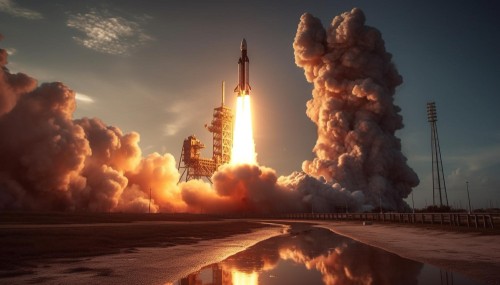
China has achieved a significant milestone in its space exploration efforts with the successful maiden flight of the Long March 12B carrier rocket. On Monday, the rocket launched from the Jiuquan Satellite Launch Center, marking a considerable advancement in China’s space capabilities. It successfully reached its designated orbit and deployed the 10th batch of the Spacesail Constellation communication satellites.
The Long March 12B, standing approximately 72 meters tall, currently holds the title as China’s most powerful single-body rocket. The two-stage launch vehicle is equipped with 10 engines fueled by liquid oxygen and kerosene, collectively producing about 800 metric tons of thrust at liftoff. This allows it to carry a payload exceeding 20 tons into low-Earth orbit. Since development commenced in September 2024, engineers have incorporated cutting-edge technologies to enhance its performance and efficiency, such as high-performance propulsion systems, lightweight structures, optimized fuel management, and autonomous flight-control software that can handle in-flight anomalies.
Looking ahead, engineers are preparing for future tests aimed at recovering and reusing the rocket’s first-stage booster. Should these efforts prove successful, a reusable version of the Long March 12B could be operational in the years to come, further advancing China’s space capabilities.
This mission also contributed to the expansion of the Spacesail Constellation, a satellite network in low-Earth orbit designed to offer high-speed global broadband internet services. With over 160 satellites now launched, the project aims to deploy more than 10,000 satellites by 2030, significantly enhancing global internet coverage.
This successful launch underscores China’s growing influence in the commercial space sector and its ambition to expand satellite internet coverage worldwide. The Long March 12B’s successful entry into orbit and satellite deployment represent a crucial step in achieving these long-term technological and strategic goals.