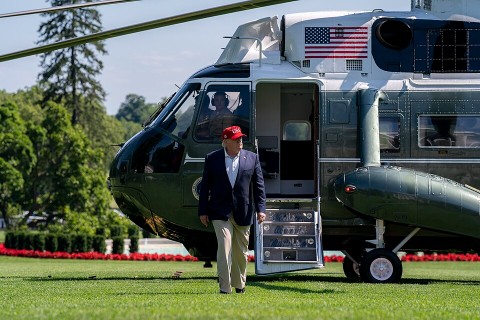
In a move that could potentially strain U.S.-China relations, former President Donald Trump announced on Wednesday his intention to speak with Taiwan’s President Lai Ching-te. This would mark an unprecedented step for a U.S. leader since Washington shifted diplomatic recognition from Taipei to Beijing in 1979. Trump made these remarks at Joint Base Andrews in Maryland, emphasizing his openness to discussing what he described as the “Taiwan problem.” In response, Taiwan’s foreign ministry expressed that President Lai would welcome a conversation with Trump.
Direct communication between U.S. and Taiwanese presidents has been absent since the diplomatic shift, although Trump stirred controversy as president-elect in 2016 by speaking with then-Taiwan President Tsai Ing-wen, which prompted a formal complaint from China. Beijing, which considers Taiwan a part of its territory, has not ruled out using force to assert control over the island, especially in light of ongoing U.S. military support for Taiwan. Despite Trump’s comments suggesting a potential conversation with Lai, no call had been scheduled as of yet.
Trump’s administration has sold more weapons to Taiwan than any previous U.S. administration, utilizing these sales as leverage in negotiations with China. However, Trump’s recent remarks have created ambiguity around his stance on a significant weapons sale to Taiwan, valued at up to $14 billion, after his visit to Beijing. This uncertainty has led Beijing to reportedly delay approving a visit by the Pentagon’s undersecretary of defense for policy, Elbridge Colby, while awaiting Trump’s decision on the arms deal.
China’s sensitivity to U.S.-Taiwan interactions is longstanding, and any direct conversation between Trump and Lai would likely provoke Beijing. Meanwhile, Lai has expressed readiness to reassure Trump of Taiwan’s commitment to maintaining the current status quo across the Taiwan Strait. Lai has stated that it is China, through its military expansion in the Indo-Pacific, that destabilizes regional peace. He emphasized Taiwan’s pursuit of democracy and freedom, asserting that no country should annex Taiwan.
Under U.S. law, the country is committed to ensuring Taiwan can defend itself, a policy supported by both Republican and Democratic lawmakers. Taiwan’s strategic significance is underscored by its position as the fourth-largest trading partner of the U.S., largely due to its exports of advanced semiconductors crucial to the global economy. This dynamic adds layers of complexity to the U.S.-China-Taiwan relations, as Washington navigates its commitments and diplomatic engagements in the region.